Tap to skip
Press
ESC
to skip
Products
Blog
About Us
Pricing
Login
Published: September 19, 2025
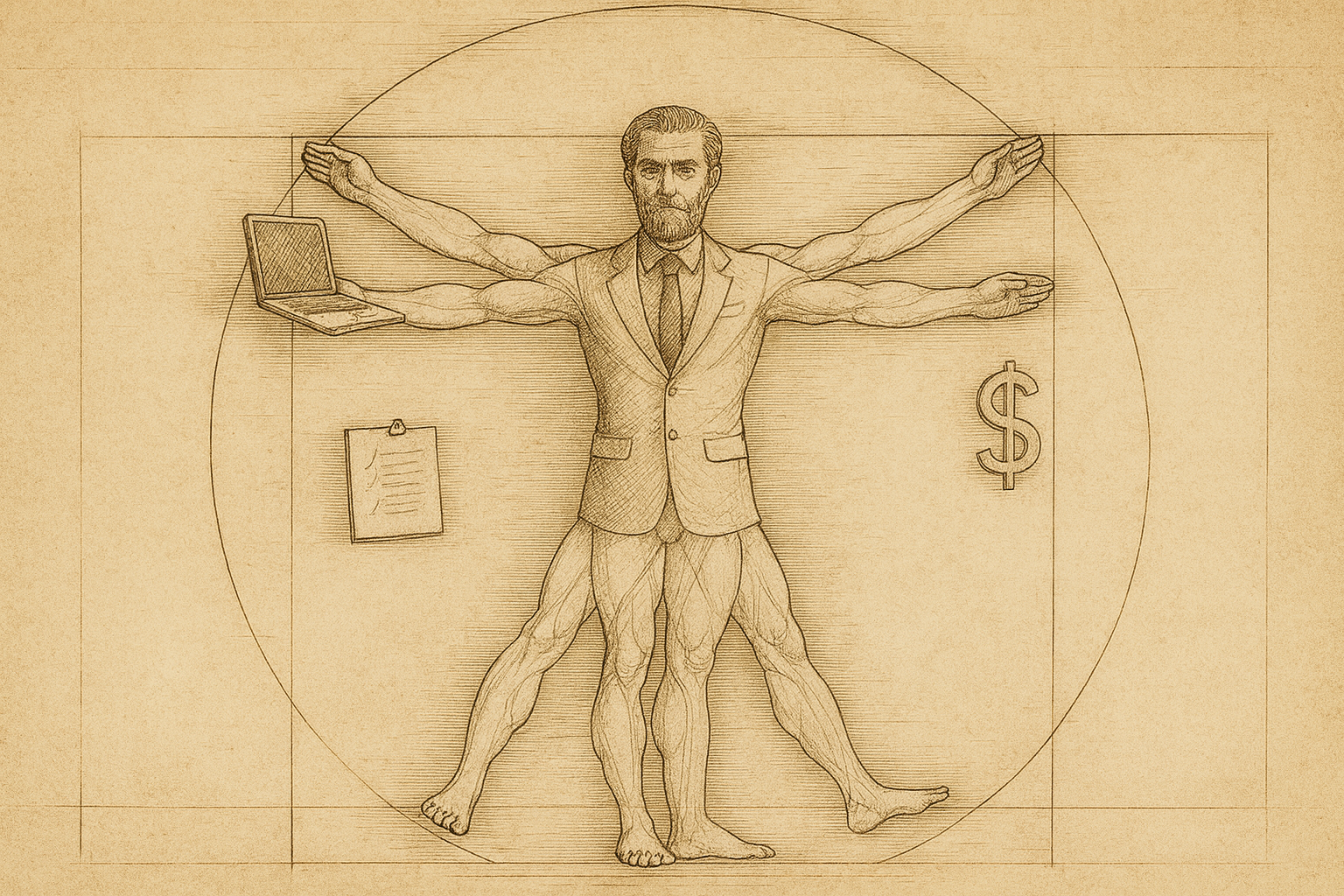
Dawn of the Renaissance Fractional CXO
Umar Manzar
Fractional CFO
Let me start with a confession. I am really good at financial strategy, but terrible at remembering which vendor contract belongs to which client. I can spot a cash flow issue from a mile away, but sometimes forget whether it was Company A or Company B that rejected that pricing model last quarter.
This is not incompetence. It is being human. And as a fractional CFO serving five companies, I have learned that success is not about being flawless. It is about doubling down on your strengths while building systems that support the rest.
Most fractional executives know the math. Five clients, forty hours, eight hours per company per week. But what that math does not capture is the cost of switching. On paper, I might have a focused day. In reality, I move from a SaaS company's unit economics at nine, to a manufacturing firm's debt restructuring at eleven, to a biotech's burn rate by two. It is not just about shifting spreadsheets. It is about changing industries, mindsets, and decision frameworks entirely.
There is research that says context switching costs us twenty three percent in productivity. But the real impact is not the number. It is the feeling of showing up to a client meeting ninety five percent present because five percent of your brain is still replaying the last conversation. That five percent makes the difference between being good and being great. And I do not want to be good.
The Split We Do Not Talk About
The irony is that most of us in these roles are excellent at the hard parts. We bring decades of pattern recognition, battle scars from real decisions, and cross functional exposure that helps us solve problems most internal teams miss. I have helped close eight figure rounds.
I have stress tested business models across sectors. I know what to watch for and when to sound the alarm.
But none of that makes me immune to forgetting whether we greenlit a hiring plan six months ago. Or which vendor integration got paused. Or what slide we pulled from the last board deck because it sparked too many questions.
We are strategic operators, but we are also human. We bring high value judgment, but we live in the same messy calendar chaos as everyone else. That is the dilemma.
And that is where NexEng comes in. It is not here to replace anything. It is here to remember everything.
NexEng maintains clean, separate, secure contexts for every client. That offhand Slack message I barely remember sending? It surfaces it. The financial model we almost ran with last quarter? Instantly retrievable. When I walk into a board meeting, I do not waste energy reconstructing what happened. I use that energy to focus on what matters next.
What This Changes
The shift is hard to overstate. I used to spend Sunday nights trying to prep for the week, reviewing notes, second guessing whether I had missed something. Now I spend that time thinking. Prioritizing. Anticipating. The work has not changed, but how I show up for it has.
Clients notice too. They feel more supported. They feel like I understand them better. And they are right. I am still the same CFO. Same skills, same flaws. But now I have a system that amplifies the first and catches the second.
This is what the next generation of fractional leadership looks like. It is not about being everything to everyone. It is about being the best version of yourself for every company that trusts you with a seat at the table.
The math has not changed. Five companies, forty hours. What has changed is what I can deliver in those hours.
We are stepping into the Renaissance of the fractional CXO. A time when executives are not just trying to keep up, but showing up fully prepared, fully contextualized, and fully focused. NexEng is not just a tool. It is the memory, the logic, and the quiet partner that lets your best work rise to the top.
And that is the only kind of scaling I am interested in.