Tap to skip
Press
ESC
to skip
Products
Blog
About Us
Pricing
Login
Published: September 26, 2025
The Newtonian Prism:
How NexEng Refracts Memory into Intelligence
Anoop Dixith
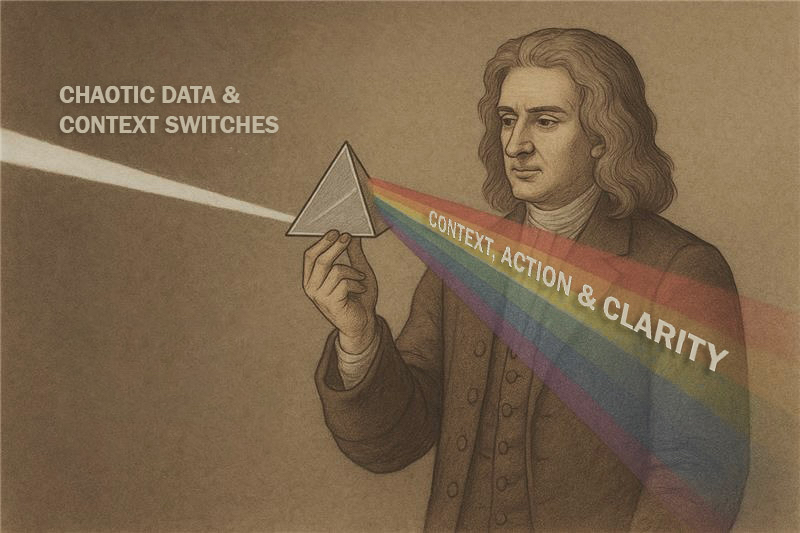
In 1666, Newton revealed hidden complexity within white light using a simple prism. Today's enterprises face a parallel challenge: their collective memory, including terabytes of recordings, documents, and messages, is the organizational equivalent of Newton's white light: dense, overwhelming, and seemingly uniform. On its own, it blinds rather than illuminates.
The Context Crisis
According to Harvard Business Review, Fortune 500 companies lost billions annually when institutional memory fails to become actionable intelligence. Nearly half of critical knowledge exists only in individual minds. When people leave, this knowledge vanishes. This was always true, but it is going to be compounded in the new fractional economy where CXOs will manage multiple clients.
Let's look at another dilemma from a fractional executive perspective. A fractional CFO manages five clients, each demanding complete attention with fractional time. They spend weekends reconstructing context instead of generating insights and taking action. Meanwhile, marketing discoveries never reach product teams. Sales patterns don't inform strategy. Every department operates in its own bubble, creating organizational amnesia where yesterday's lessons disappear today.
The human brain simply wasn't built for this. We need a better way both for businesses and professionals serving those businesses.
Refracting Complexity into Clarity
NexEng mirrors Newton's principle: breaking complexity into manageable pieces, then recombining them into something more powerful.
Our Ingestion Layer doesn't just store data, it preserves relationships. Every email, document, conversation maintains its organizational DNA. We maintain living memory that evolves with your organization, not data graveyards where information goes to die.
The Context Engine builds knowledge graphs that actually understand relationships. Using high performance embedding systems, we maintain institutional memory across decades. But here's what matters most: absolute boundaries between clients. Each context exists in its own secure universe. A fractional executive's knowledge about Company A never bleeds into Company B's world.
In a fractional ecosystem, people move in and out of roles faster than traditional employees. Continuity doesn't come from tenure; it comes from context. If knowledge isn't captured, refracted, and made accessible, every new engagement begins from scratch. Instead of compounding wisdom, companies repeat cycles, relearning the same lessons.
The Synthesis Layer is where magic happens. Through causal reasoning that understands why things happen, not just what happened, NexEng anticipates needs before they arise. Imagine having a tailored response that matches your goals and personality to your high priority email before you have even opened it; or having taken care of your invoices even before you are reminded of it; attaching your logs to your cloud provider to debug your billing issues; negotiating with a client and being reminded of a similar case from three years ago; spotting a risk pattern no one in the room recalls, but which the system brings to light. This is how context becomes foresight, and foresight fuels strategy.
Security Through Architecture
The fractional economy demands something traditional security can't provide: complete isolation between contexts while maintaining seamless access for authorized users.
We call it "cognitive isolation". Each client's universe remains completely separate through data sovereignty (your AI never leaves your infrastructure), computation on encrypted data without exposure, and continuous verification at every interaction. For regulated industries, even we can't access your context. Your secrets remain yours, period.
The Agentic Era
NexEng provides something fundamentally different from orchestration platforms: a semantic foundation where agents truly collaborate.
Within NexEng platform, you build specialized agents that share understanding, not just messages. A financial analysis agent seamlessly hands context to a compliance verification agent. They don't just pass data; they share comprehension. Each agent accesses relevant history instantly, shares findings naturally, and learns from collective experiences. This is cognitive collaboration, where agents understand context deeply and act with full organizational awareness. We will do a deep dive in upcoming blogs on our uniquely scalable agentic architecture and how they interact through an agentic mesh.
From Reactive to Proactive
Traditional systems wait for questions. NexEng anticipates needs.
Instead of Sunday scrambles preparing for Monday, NexEng assembles relevant context, identifies emerging issues, generates preliminary analyses in your style, and flags critical decisions. Through continuous background synthesis, we maintain ambient awareness of your entire operational context.
Real Impact
The results are that context switching overhead drops significantly. Institutional knowledge stays intact despite turnover. Decisions happen faster with better accuracy. Productivity multiplies for participants of the fractional ecosystem - professionals managing multiple clients.
But numbers only tell part of the story. Professionals feel "cognitively augmented" rather than overwhelmed. Companies finally have "perfect institutional memory". Clients can't tell their fractional executive isn't full time.
Conclusion
The enterprise intelligence revolution isn't about replacing humans; it's about refracting human capability through the right prism.
Will you continue losing institutional knowledge, or will you deploy the prism that transforms memory into intelligence?
Welcome to refracted intelligence. Welcome to NexEng.